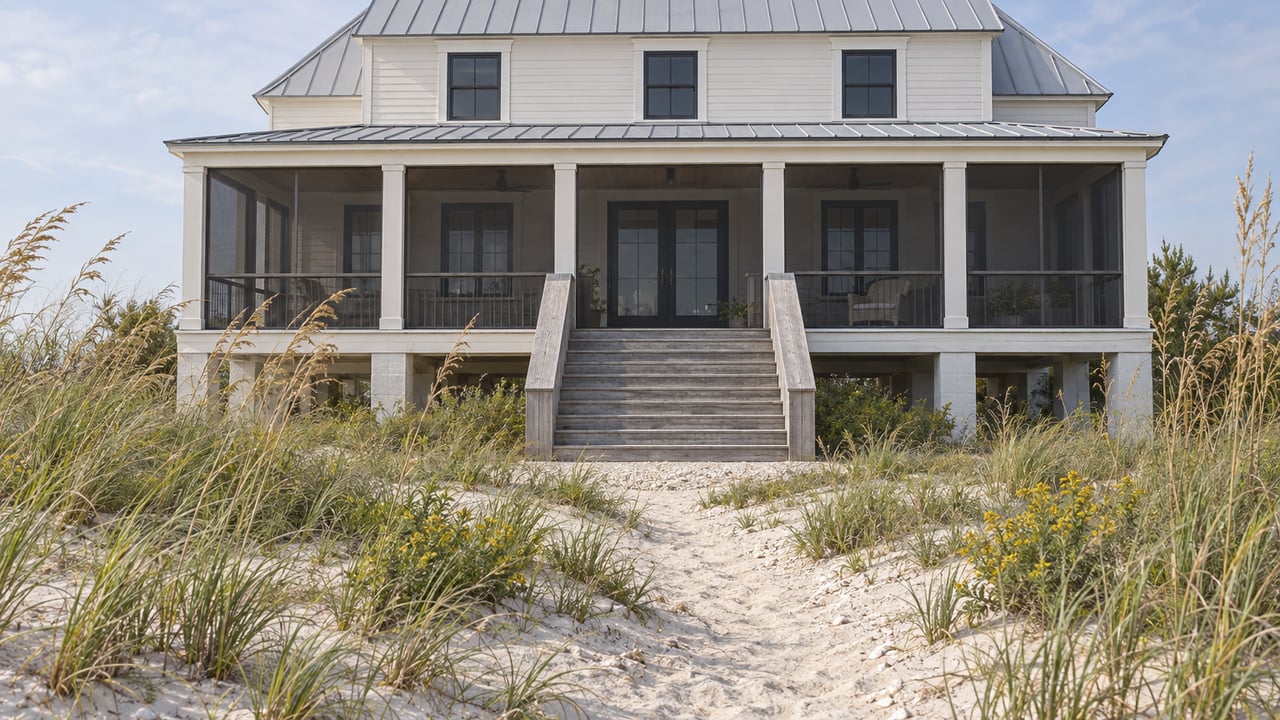
South Beach's Extra Hundred Feet Meets the End of Turtle Season
October 1, 2026
October 1, 2026
In an early-April report, WTOC quoted Heather Woolwine, the Town of Hilton Head Island's communications and marketing director: "We've had some results at this point, where we've got more than 100 feet of beach that has been added."
By the time the crews reached South Beach, the town's own numbers put the scope in sharper focus: about 750,000 cubic yards of sand pumped along roughly 10,230 feet of shoreline, from Beach Marker 8 near Beachside Drive down to Beach Marker 27 near Surf Scoter Road. Marinex Construction, the contractor on the job, worked the stretch in both directions, first north from Beach Marker 16 toward Surf Scoter, then back south toward Beachside. The town's project page lists a completion window of no later than May 31, 2026, and a rental company's own project update confirms the south end of South Beach wrapped that same month.
None of that is news to anyone who spent the spring routing around pipeline and bulldozers on the way to the marina. What's less obvious is what happens now that the machinery is gone and turtle season is closing behind it.
Renourishment on Hilton Head isn't a one-time event. The town generally schedules it every eight to ten years, and this round follows earlier full projects completed in 1990, 1997, 2006, and 2016. Woolwine's own description of the current effort as the island's first full renourishment in a decade fits the interval since the 2016 project.
The scale becomes easier to picture against a progress snapshot from early May, when Marinex reported having moved sand past Bald Eagle Road and was approaching Cedar Waxing Road with just over 75,000 cubic yards placed. That was roughly a tenth of the total the South Beach segment would eventually receive. The rest went down over the following weeks, graded and shaped by bulldozers working what the town describes as a 24-hour operation.
For anyone who owns property along that stretch, the disruption itself was brief. Individual properties typically saw three to four days of noise and equipment as the operation passed by, according to the rental company tracking the schedule for owners. That window has been closed for months now. What's left is the sand.
Beach width is only half of what changed this fall. The other half runs on a calendar that has nothing to do with construction schedules.
Sea turtle nesting season on Hilton Head runs into October, and for most of the summer that means marked-off sections of dry sand where loggerhead nests are incubating. Morning walkers get used to routing around the stakes and tape, especially on the wider stretches of beach where nests tend to sit furthest from the water. Once the season closes at the end of October, those markers come down, and the beach opens back up without the usual detours.
Most years, that reopening is the only change worth noticing. This year, it's landing on a beach that's also measurably wider than it's been in a decade. The project wrapped in May, while turtle season closes at the end of October; the two changes meet on South Beach this fall.
Walk the stretch from South Beach Marina south past Beachside Drive and the difference shows up in the distance between the dune line and the waterline, not in anything dramatic. It's the kind of change that's easy to miss if you're not looking for it and impossible to miss once someone points it out. A hundred feet of added beach, the figure Woolwine cited back in April, is roughly the length of a bocce court laid end to end. Multiply that across the length of South Beach and the amount of dry sand available at low tide this October is simply larger than it was last October, or the October before that, or any October back to 2016.
The bike path connecting South Beach Marina to the beach access points hasn't changed. What has changed is what's waiting at the end of it. For a resident who bikes down most mornings, that means:
None of this requires a special trip or a change in routine. It's the same walk from the same access points. The beach underneath it is just bigger than it's been in years, and once turtle season closes at the end of October, the nest markers will come down.
Renourished sand doesn't stay put forever. The town's monitoring program tracks more than 60 stations along the coast specifically because erosion resumes the moment a project wraps, and the wide, flat profile crews leave behind in May typically narrows some as storms and normal tidal action redistribute sand through the following seasons. That's the same pattern the town has documented after every renourishment cycle since 1990. Fall and early winter are usually when a freshly renourished beach still looks closest to its post-project width, before spring storms start the slow work of reshaping it again.
That makes this particular stretch of fall on South Beach a fairly narrow window. The sand is as wide as it's been in a decade, the nest markers are about to disappear, and the next renourishment cycle is the better part of ten years away. Anyone who walks this beach regularly is seeing something that won't look quite the same by next fall.
If you spend time on South Beach and want to talk through what a wider shoreline actually means for a specific address, or you're simply curious how this stretch compares to what you remember from a few years back, Tyler Stone walks this part of Sea Pines often enough to have a current read on it.


Whether you’re buying your first home, selling a luxury property, or investing in Hilton Head Island real estate, Tyler Stone provides expert guidance, local knowledge, and a client-focused approach. From the initial consultation to closing, he ensures a smooth, stress-free experience tailored to your unique goals.